A 10-Minute Map of AI Concepts
AI is becoming part of almost every digital product, but understanding the terminology can feel overwhelming. I created this guide to organize the core AI and machine learning concepts I learned into a simple roadmap for product designers, UX professionals, and anyone working closely with AI.
This isn't a deep dive into algorithms or math. Instead, it's a practical overview of how the key concepts connect, where they appear in real products, and why they matter when designing thoughtful AI experiences.
01
Introduction
AI is becoming part of almost every digital product, yet many designers still struggle to connect the terminology. Concepts like machine learning, deep learning, neural networks, overfitting, and reinforcement learning are often explained separately, making AI feel more complex than it needs to be.
I created this guide to connect those ideas into one practical learning map that explains how the concepts relate, where they appear in real products, and why they matter when designing AI-native experiences.
02
My Goal
My goal was to turn core AI and machine learning concepts into a quick, accessible guide for product designers and other non-technical collaborators.
Rather than listing definitions, I wanted to show how the concepts connect, why they matter in real products, and how this knowledge helps designers collaborate more effectively with engineers, researchers, and product managers.
03
Why This Matters
Designers don't need to become machine learning engineers, but they do need to understand how AI systems behave. Decisions about training data, model limitations, confidence, feedback, and human control all shape the user experience.
A basic understanding of AI helps designers ask better questions, collaborate more effectively with cross-functional teams, and make more informed design decisions when building AI-powered products.
For design peers
A quick reference for understanding common AI and machine learning terminology.
For product collaboration
A foundation for asking better questions when working with technical teams.
04
A Designer's Guide to AI Foundations
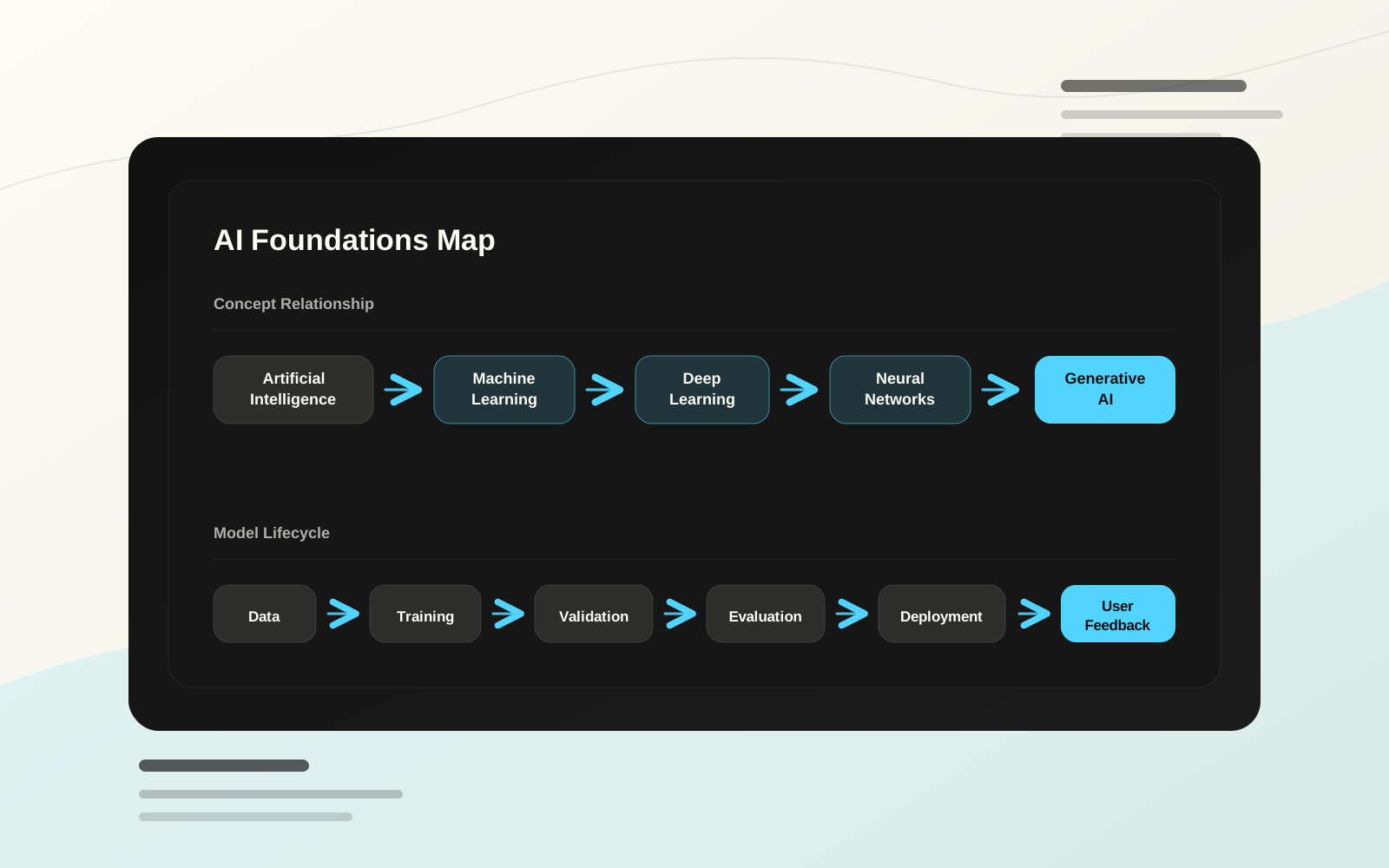
This 10-minute visual guide organizes the core AI concepts into a clear learning path. It starts with the relationship between AI, machine learning, deep learning, neural networks, and generative AI, then walks through model training, validation, optimization, reinforcement learning, and responsible AI design.
The Big Picture
AI is the broad field of creating systems that perform tasks associated with human intelligence. Machine learning is one way of building those systems by allowing models to learn patterns from data. Deep learning uses multilayer neural networks, while generative AI applies these methods to create new content such as text, images, audio, and code.
Machine Learning
Definition: Machine learning allows computers to identify patterns from data instead of relying only on manually written rules.
Examples
- House-price estimation
- Fraud detection
- Recommendation systems
- Spam filtering
Design perspective: The model's output depends on the data and assumptions used to train it. Designers should understand what information the system uses and how uncertainty is communicated.
Key takeaway: Machine learning replaces some fixed rules with patterns learned from examples.
Deep Learning and Neural Networks
Deep learning is a form of machine learning that uses neural networks with multiple layers to identify complex patterns.
A neural network is made of connected layers that transform input information into an output or prediction.
Input layer
The first layer that receives data such as pixels, words, sounds, or product signals.
Hidden layers
Intermediate layers that transform the input into patterns the model can use.
Output layer
The final layer that produces a prediction, classification, recommendation, or generated response.
Weights
Adjustable values that shape how strongly one signal influences another inside the network.
Learning through repeated feedback
The model compares predictions with expected results and updates its weights over many training passes.
Examples
- Face ID
- Image classification
- Speech-to-text
- Large language models
Design perspective: Neural networks learn statistical patterns. They do not understand users or situations in the same way people do.
Key takeaway: Powerful pattern recognition still requires thoughtful product framing and human judgment.
Training, Validation, and Testing
Training data
The examples used to help a model learn.
Validation data
Separate examples used during development to check how well the model performs beyond the training set.
Test data
Previously unseen examples used to estimate final performance.
Training loss
A signal that measures how far a model's predictions are from expected results during training.
Validation performance
A check on whether the model performs well on data it did not directly learn from.
Generalization
The model's ability to handle new examples instead of only the examples it trained on.
Overfitting
A pattern where the model performs well on training examples but poorly on new inputs.
Healthy learning: Training performance improves and validation performance also improves.
Overfitting: Training performance continues improving while validation performance becomes worse.
Design perspective: A model that performs well in a controlled environment may still fail with real users, unfamiliar inputs, or changing conditions.
Key takeaway: The goal is not memorizing training data. It is performing reliably in new situations.
Improving a Model
Epoch
One complete pass through the training dataset.
Batch size
The number of training examples processed before updating the model.
Learning rate
How much the model adjusts during each learning step.
Hyperparameter
A setting that influences how the model learns.
Dropout
A method that temporarily removes some neural-network connections during training to reduce overfitting.
Model improvement requires balancing technical performance with product constraints:
- Accuracy
- Speed
- Cost
- Reliability
- Privacy
- User experience
Design perspective: The technically most accurate model may not be the best product choice if it is too slow, costly, unpredictable, or difficult for users to understand.
Key takeaway: Product teams must define what "good" means for both users and the business.
Reinforcement Learning
Definition: Reinforcement learning teaches an agent by allowing it to take actions, receive rewards or penalties, and improve its decisions over time.
Agent
The system that chooses actions and learns from the result.
Environment
The situation, system, or world the agent acts within.
Action
A choice the agent can make in the environment.
Reward
A positive or negative signal that tells the agent how useful an action was.
Exploration
Trying less familiar actions to discover better outcomes.
Exploitation
Choosing actions that already seem likely to produce a good result.
Gamma
Gamma controls how much the agent values future rewards compared with immediate rewards.
Examples
- Game-playing systems
- Robotics
- Resource optimization
- Recommendation and control systems
Design perspective: Reward design matters. If a system is rewarded for the wrong behavior, it may optimize the metric while creating undesirable outcomes for users.
Key takeaway: The behavior an AI learns depends heavily on what the product defines as success.
Responsible AI Products
Accuracy
Does the system produce sufficiently correct and reliable results?
Explainability
Can users understand the output or its limitations?
Fairness
Does the system perform consistently across different people and situations?
Human control
Can users review, correct, override, or reject the AI output?
Trust
Does the experience communicate uncertainty, system status, data use, and limitations honestly?
Key takeaway: Responsible AI is also an interaction, content, accessibility, research, and product-strategy concern.
A Designer's Cheat Sheet
Term
Training data
Meaning
The examples used to teach the model.
Designer perspective
Does the data represent the users and situations we are designing for?
Term
Validation
Meaning
Checking performance with data not directly used for learning.
Designer perspective
Does the experience still work outside ideal scenarios?
Term
Training loss
Meaning
A measurement of how far predictions are from expected results.
Designer perspective
Is model improvement also creating meaningful user improvement?
Term
Overfitting
Meaning
The model performs well on training examples but poorly on new ones.
Designer perspective
How will the product respond to unfamiliar users or inputs?
Term
Epoch
Meaning
One complete pass through the training dataset.
Designer perspective
Is continued training improving real performance or only memorization?
Term
Hyperparameter
Meaning
A setting that controls the learning process.
Designer perspective
What product tradeoffs are affected by these settings?
Term
Dropout
Meaning
A method used to reduce overfitting.
Designer perspective
How are we testing whether the model generalizes?
Term
Inference
Meaning
The moment when a trained model produces an output for a new input.
Designer perspective
How fast, reliable, and understandable is the result?
Term
Gamma
Meaning
How strongly a reinforcement-learning agent values future rewards.
Designer perspective
Is the system optimizing an immediate action or a longer-term user outcome?
05
My Process
I approached this article as both a learning exercise and an information design challenge. Rather than collecting definitions, I focused on creating a guide that helps designers quickly understand how AI concepts connect and why they matter in product work.
Step 1
Identify the core concepts
I selected the foundational AI topics that designers are most likely to encounter, from machine learning and neural networks to model training, reinforcement learning, and responsible AI.
Step 2
Prioritize what matters
Instead of covering every technical detail, I focused on the concepts that influence product decisions, cross-functional collaboration, and user experience.
Step 3
Build a learning path
I organized the content from broad ideas to more advanced topics, allowing readers to build understanding step by step rather than jumping between disconnected terms.
Step 4
Translate technical language
I rewrote technical concepts in plain language while keeping the key relationships, limitations, and tradeoffs accurate.
Step 5
Connect AI to product design
Each section includes practical examples and design implications to show how AI concepts appear in real products and everyday design decisions.
Step 6
Design for quick reference
I structured the guide as a 10-minute read with diagrams, concise explanations, and scannable sections, making it easy to revisit whenever needed.
Step 7
Publish as part of the AI Playground
I integrated the guide into the Blog & Reflections section of my AI Playground, using the same visual language and structure as the rest of the portfolio to create a consistent learning experience.
06
Reflection
As AI becomes an essential part of digital products, designers need enough knowledge to ask better questions, collaborate with technical teams, and make more informed decisions. Building this guide helped me connect the core AI concepts while shifting my mindset from designing interfaces to thinking about how AI-powered products create successful user experiences. I'll continue updating this guide as AI evolves and as I gain more experience designing AI-native products.