The Data Behind the AI Experience
What learning about data has changed about the way I think about AI-powered products.
01
The Moment It Clicked
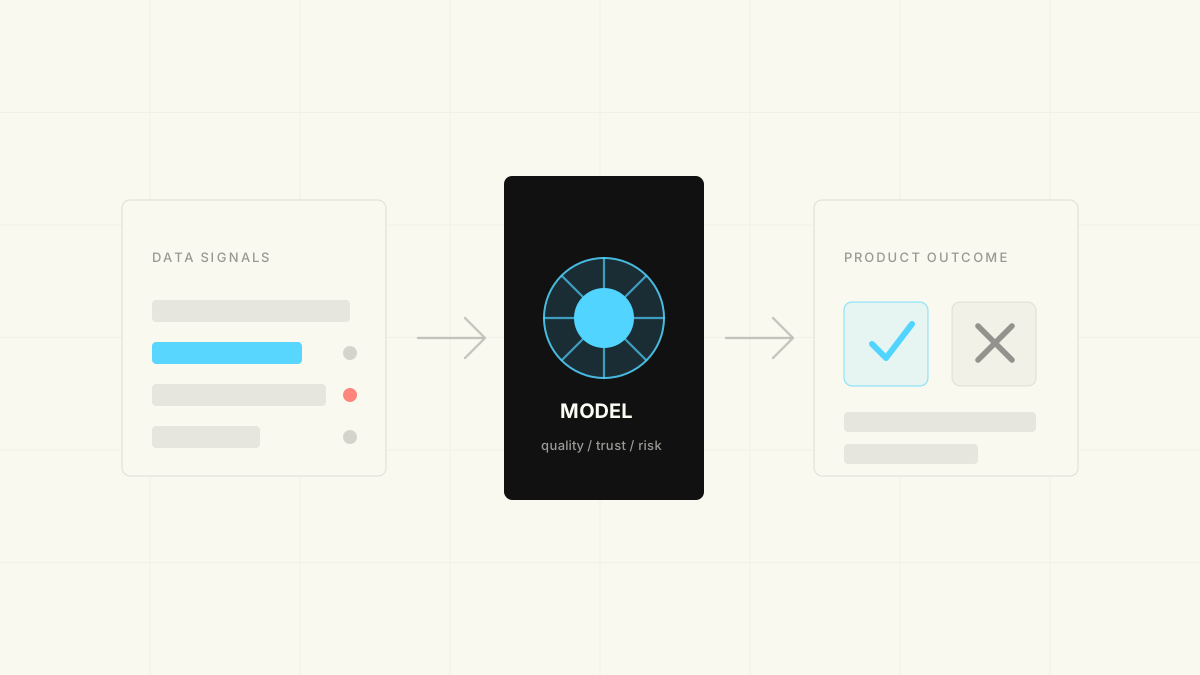
I expected the hardest topics in AI and ML to be neural networks, deep learning, and model selection. What changed my perspective most was something more fundamental: the model is only as useful as the data behind it.
That realization changed the questions I ask as a designer. Instead of focusing only on what the model can do, I now ask:
Questions I now ask
- Where did the data come from?
- Does it represent the intended users?
- What information is missing?
- Which mistakes will affect people most?
- What happens when real-world behavior changes?
These questions are not only technical. They shape product quality, user trust, and business risk.
02
Data Quality Becomes Product Quality
Training data may contain missing values, duplicate records, inconsistent formats, or incorrect labels. When the data is unreliable, the model learns from unreliable examples.
This helped me understand why a weak interface or model does not always cause a poor AI experience. Sometimes the system lacks accurate information to make a useful decision.
Missing values
Important inputs never make it into the examples the model learns from.
Duplicate records
Repeated patterns can quietly make some behaviors appear more common than they are.
Inconsistent formats
Signals become harder to compare when the same thing is recorded in different ways.
Incorrect labels
The model learns the wrong relationship between an input and the expected outcome.
The user experience begins long before the result appears on the screen. Understanding the data behind a feature helps us identify where the experience may fail.
03
High Accuracy Can Still Hide Failure
Imbalanced data changed how I interpret model performance. Imagine a fraud detection system where only 1% of transactions are fraudulent. A model could label every transaction as legitimate and still report 99% accuracy. The number looks impressive, but the product fails at its main purpose.
Transactions
10,000
Fraudulent
100
Flagged fraud
0
A model that labels every transaction as legitimate can still report 99% accuracy, while missing the product's main purpose.
Designers can help teams move beyond a single success metric by asking:
- Which errors are most harmful?
- Who experiences those errors?
- What should the product do when the model is uncertain?
04
AI Learns From Yesterday's World
Machine learning models learn from historical patterns, but people and environments continue to change. User behavior evolves. Policies change. Markets shift. New products introduce new patterns. As a result, a model that performs well at launch may become less reliable over time.
This is often described as data drift: the live data no longer matches what the model learned during training.
Training data
Yesterday's world
Live data
Behavior changes
Feedback loop
Monitor and improve
When live behavior no longer matches the original training data, the interface needs ways to slow down, ask for more information, or route the decision to human review.
Key takeaway: AI is not a feature that can be released and left unchanged. It requires continued monitoring, feedback, and improvement.
For designers, considering how the interface should respond when confidence drops, predictions become less reliable, or the system needs more information is an important part of AI experience design.
05
Bias Often Begins Before the Model
Bias is often discussed as something AI creates, but it frequently begins in the data. Historical datasets reflect past decisions, existing processes, and human behavior. Some users may be underrepresented. Important context may not have been recorded. Unequal access may appear in the data as a neutral pattern.
A model can learn and repeat those patterns without being intentionally designed to discriminate. This shifted my focus from asking only, "Is the model fair?" to asking, "Who is represented in the data, and who may be missing?"
Represented
The people and behaviors the dataset captures often become the system's default idea of normal.
Underrepresented
People with fewer examples may experience weaker predictions, less relevant outcomes, or more friction.
Unrecorded context
Important circumstances can disappear when historical data only records the final decision.
Designers already ask similar questions when evaluating accessibility and inclusion. AI extends that responsibility from the interface into the data that shapes the experience.
06
What This Changes for Designers
Designers may not prepare datasets or train models, but we can help connect technical behavior to user needs. We can identify where failures may occur, shape feedback loops, and make uncertainty easier to understand.
Questions for AI product conversations
- Does the data reflect the intended users and use cases?
- Which prediction errors create the greatest risk?
- How should the product behave when confidence is low?
- Can users review, correct, or reject the result?
- How will the team know when performance changes?
- What feedback will help improve the system?
These questions create stronger collaboration by connecting model performance with experience, trust, and product impact.
07
Looking Ahead
AI is a larger system shaped by data quality, human decisions, changing conditions, and continuous feedback.
That perspective encourages me to look beyond the final interface. A trustworthy AI experience depends on what happens before the result is shown, how the product handles mistakes, and how the system improves after launch.
Moving forward, I will explore model evaluation, explainability, human oversight, and responsible AI governance to see how designers contribute earlier and more meaningfully to the development of AI-powered products.